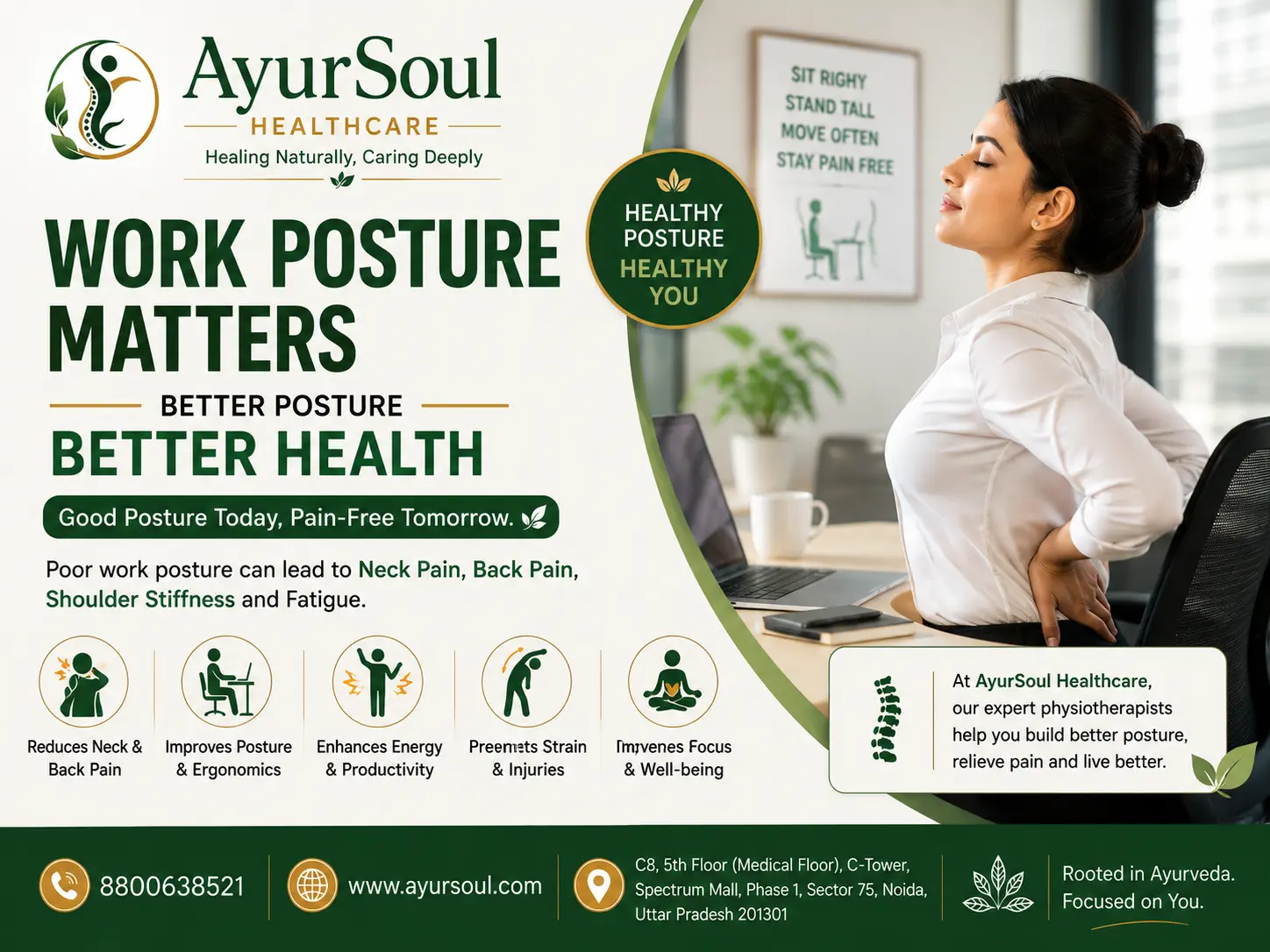
Work Posture Matters: Better Posture, Better Health
Good posture today, pain-free tomorrow.
8h+
Average desk hours per day for office workers
3×
More likely to develop neck pain with poor monitor height
30°
Forward head tilt doubles effective spinal load
20:2
20 min seated, 2 min movement break — recommended ratio
Poor work posture is one of the most common causes of neck pain, back pain, shoulder stiffness and fatigue among office workers. A physiotherapy assessment can identify the root cause and give you a personalised plan — not just generic advice.
⚠ What poor posture causes
The Hidden Cost of a Bad Chair Setup
Poor work posture rarely causes immediate pain. It builds slowly — as accumulated load on joints, muscles and nerves that were never designed to hold a fixed position for hours at a stretch.
🔴
Neck Pain
A forward head position puts up to 27 kg of effective load on the cervical spine. This strains muscles, facet joints and nerve roots.
🔴
Back Pain
Slouching flattens the lumbar curve and increases disc pressure. Sustained compression can contribute to disc bulge and muscle spasm.
🟠
Shoulder Stiffness
Rounded shoulders shorten the chest muscles and inhibit the rotator cuff. Over time this creates impingement-type pain.
🟠
Fatigue & Low Focus
Muscle groups held in poor alignment work harder to stabilise. The energy cost contributes directly to afternoon tiredness.
When to seek assessment rather than self-manage
If pain radiates down your arm or leg, if you have numbness or tingling in your hands, if pain wakes you at night, or if symptoms have not improved after two weeks — see a physiotherapist or doctor before starting any exercise programme.
🖥 Common mistakes
Six Posture Habits That Cause the Most Damage
1
Screen too low or too far away
You tilt your head down or crane forward. Fix: top of screen at or just below eye level, arm’s length away.
2
Chair too high or too low
Feet hang or knees ride up, tilting the pelvis. Fix: feet flat on floor, thighs roughly parallel to ground.
3
Keyboard too far from the body
Arms reach forward, pulling the shoulders. Fix: elbows bent at 90°, keyboard close so wrists are not extended.
4
Sitting cross-legged or side-loaded
Twists the pelvis asymmetrically. Fix: both feet flat, weight even through both sitting bones.
5
Phone propped between ear and shoulder
Compresses the neck’s lateral structures. Fix: use a headset or speakerphone for calls over a minute.
6
Never getting up
Even perfect posture degrades disc nutrition. Fix: stand or walk for 2 minutes every 20–30 minutes.
🪑 Workstation setup
The Ergonomic Workstation — Seven Points to Check
A proper ergonomic setup removes the structural reasons your body gets stuck in a bad position. Work through this checklist before adjusting anything else.
💺 Chair height
Feet flat on the floor or a footrest, knees at 90°, thighs parallel to the ground. Do not sit on the edge — back of thighs should be fully supported.
📐 Lumbar support
Lumbar support should sit in the inward curve of your lower back, not at your waist. A small rolled towel works if there is no built-in support.
🖥 Screen height
Top of the monitor at or just below eye level. On a laptop full-time, use an external keyboard and raise the screen on a stand — laptop-only posture is the leading cause of desk-related neck pain.
📏 Screen distance
Arm’s length from face — roughly 50–70 cm. If you lean in to read, increase font size rather than adjusting your posture.
⌨️ Keyboard & mouse
Keyboard at a height where elbows are at 90° and wrists are straight. Mouse immediately next to the keyboard. A wrist rest is for pausing, not for typing on.
💡 Lighting
No bright light source behind or directly in front of the screen. Sidelighting is usually best. A warm desk lamp for evening work reduces eye strain.
⏱ Movement breaks
Set a timer: every 20–30 minutes, stand for 2 minutes and walk briefly. Disc nutrition depends on movement — sustained sitting starves discs of the fluid they need.
🏃 Posture exercises
Seven Physiotherapy Exercises for Office Workers
These are standard physiotherapy exercises for desk-related posture problems, suitable for most people without existing injury. If you have current pain, numbness or a known spine condition, get assessed before starting.
01
Chin Tuck
Sitting tall, gently draw your chin straight back — as if making a double chin. Hold for 5 seconds. You should feel a gentle stretch at the base of the skull. Do not tilt your head down.
10 reps × 3 sets · 3–4 times daily
02
Shoulder Blade Squeeze
Draw both shoulder blades together and slightly downward — as if holding a pencil between them. Hold 5 seconds, release. Do not shrug your shoulders up.
15 reps × 3 sets · twice daily
03
Chest Opener Stretch
Clasp hands behind your back. Draw shoulders back and down, lifting your chest slightly. Hold 20–30 seconds. Counteracts the forward-rounded posture of prolonged typing.
3 holds of 30 sec · every 2 hours
⚠ Skip if you have a current shoulder injury or pain on movement.
04
Cervical Side Stretch
Sitting tall, slowly tilt your right ear toward your right shoulder until you feel a gentle pull on the left side of the neck. Hold 20 seconds. Repeat left. Do not pull on your head.
3 × each side · morning and evening
05
Thoracic Extension
Sit with a firm chair-top edge at upper-back level. Place a rolled towel along the edge. Gently extend your upper back over it, looking up. Hold 5 seconds. Opens mid-back segments compressed from sitting.
8–10 gentle extensions · once daily
⚠ Avoid if you have osteoporosis or mid-back pain — check with a physiotherapist first.
06
Hip Flexor Stretch
Kneel on one knee, the other foot forward. Shift hips forward gently until you feel a stretch in the front of the kneeling hip. Hold 30 seconds per side. Sitting shortens hip flexors, tipping the pelvis forward.
3 × 30 sec each side · daily
07
Standing Wall Angels
Stand with back against a wall, feet 15 cm out. Press lower back, upper back and head against the wall. Raise arms to a goalpost shape with elbows and wrists touching the wall. Slowly slide arms up, return slowly.
10 slow reps · twice daily
A note on exercise programmes
These exercises address common postural patterns and are not a substitute for a physiotherapy assessment identifying your specific imbalances. If pain increases during or after any exercise, stop and seek advice.
✅ Why it matters
What Better Posture Can Help With
😌
Reduced neck & back pain
🪑
Better ergonomics & comfort
⚡
Improved energy & productivity
🛡
Prevents strain & overuse injuries
🎯
Better focus & well-being
🏥 At AyurSoul
What a Posture Assessment at AyurSoul Covers
A physiotherapy posture assessment is a clinical evaluation — not a generic consultation. It looks at the specific structures contributing to your pain and the patterns reinforcing it.
✓
Postural analysis
Standing and seated posture reviewed from front, side and back. Identifies where load is concentrated in your specific spine.
✓
Muscle flexibility & strength testing
Tight hip flexors, weak deep neck flexors or inhibited mid-back muscles are common contributors to postural breakdown.
✓
Workstation history
Questions about your setup, working hours, posture habits and previous episodes of pain help identify contributing factors.
✓
A personalised plan
Specific exercises, manual therapy where appropriate, and clear ergonomic adjustments tailored to your setup and your body.
❓ Common questions
Frequently Asked Questions
How many physiotherapy sessions does posture correction take?
This depends on how long the postural pattern has been established and whether there is existing pain or restriction. Simple ergonomic issues may resolve in 3–6 sessions. Longer-standing patterns with associated muscle weakness typically take 8–12 sessions and a consistent home exercise programme.
Can poor posture cause headaches?
Yes. Cervicogenic (neck-related) headaches are common among desk workers and arise from sustained tension and restriction in the upper cervical spine. They typically present as a dull ache starting at the base of the skull spreading toward the forehead. Posture correction and manual therapy can help — but persistent or severe headaches should be assessed medically first.
Is a standing desk better than a sitting desk?
A height-adjustable desk that allows alternating between sitting and standing is better than either alone. Prolonged standing has its own problems. The goal is variety of position and regular movement, not simply switching from one sustained posture to another.
How is physiotherapy different from a massage for posture-related pain?
A massage addresses symptomatic muscle tension and can provide temporary relief. Physiotherapy looks at why the tension is there — the structural, movement and ergonomic factors — and addresses those through exercise, manual therapy and education. For recurrent pain that keeps coming back after massage, a physiotherapy assessment typically finds the underlying reason.
Can Ayurvedic therapies complement physiotherapy for posture correction?
Yes. Ayurvedic therapies such as Abhyanga (warm oil massage), Greeva Basti (medicated oil pooling at the neck) and Kati Basti (for the lower back) can support muscle relaxation alongside a physiotherapy programme. AyurSoul offers both disciplines under one roof, and a care plan can incorporate both where appropriate.
Is work posture correction suitable for someone who works from home?
Yes — and home-office setups are often worse than corporate ones because they were rarely designed for full working days. A physiotherapy assessment covers your specific setup, whether at an office desk or a kitchen table.
Important: This page is educational and general. It is not medical advice. If you have current pain, numbness, tingling, or any existing diagnosis, seek a clinical assessment before starting any exercise programme. For urgent or worsening symptoms, see a doctor.